

The festival, tour, and corporate event season has solidified a demanding technical standard: structures that are quick to assemble, configurable, and offer traceable safety guarantees. In Spain, the demand for modular stages and lifting towers has grown alongside more professional promoters, increasingly complex riders, and stricter risk audits. In this context, the combination of robust platforms, properly sized trusses, and certified towers allows for working with real-world loads of speakers, lighting, and video equipment without compromising the safety of the audience or the technical crew. This article offers a practical guide for professionals on designing, assembling, and operating modular stages with state-of-the-art lifting towers, focusing on GUIL solutions and compliance with current regulations.
Why choose modular scenarios in 2025: efficiency, scalability and security
The modular stage has become the foundation of any efficient production due to its versatility. The ability to configure surfaces in a wide variety of sizes and heights allows the technical setup to be adapted to municipal venues, plazas, auditoriums, or pavilions without having to reinvent the system each time. When the same set of platforms, legs, and accessories can handle everything from an intimate showcase to a medium-sized festival, logistics are simplified, the cost per event decreases, and the return on investment increases. Furthermore, modern aluminum and phenolic board platforms, combined with joining systems and skirting, improve the overall rigidity and facilitate integration with stairs, ramps, and walkways. At Tempo Shop, the Hardware and Stages category brings together precisely these solutions, allowing you to plan everything from the primary structure to the finishing touches that make all the difference in safety and a professional finish. If you want to explore the offerings by product families and compatibility, you can start with the Hardware and Stages section, where you'll find the key components for stage design, ground support assemblies, and lifting solutions.
Safety is not an optional consequence, but rather the very reason for the modular system's existence. A platform that maintains strict manufacturing tolerances and a controlled deflection rate in its supports minimizes vibrations and resonance phenomena that affect microphones and sensitive equipment. At the same time, the ease of leveling legs or spindles shortens setup times and reduces the need for correction maneuvers under pressure, which is when most human errors occur. Furthermore, scalability is evident in the system's lifespan: when the structure adheres to a manufacturer's standard with readily available spare parts and accessories, preventive maintenance is manageable, and the system retains its value in the professional market.
GUIL as the backbone of the system: compatible platforms, trusses and lifting towers
Working with a cohesive ecosystem simplifies decision-making. GUIL is a Spanish brand with a renowned track record in towers, trusses, and platforms for professional use, and its catalog naturally aligns with the needs of the audio, lighting, and video industries. On Tempo Shop, the brand channel allows you to filter by product families, heights, load capacities, or accessories, saving time in pre-sales and previews. For a quick overview of the portfolio grouped by category, you can visit the GUIL page on Tempo Shop , where you'll find everything from platforms with different leg systems to top-loading and front-loading telescopic towers, as well as modular ground support structures.
This catalog consistency is particularly evident in the compatibility of accessories: adapters for raising square trusses, joining systems, wheeled bases for horizontal transport, and mounting solutions for line arrays or lighting bars. The availability of spare parts, the continuity of product references, and after-sales technical support are factors that reduce operational risk. In touring productions, having the same standardized parts and anchoring systems prevents improvisation and allows technical staff to rotate without an additional learning curve.
Lifting towers: top-loading and front-loading, when is each appropriate?
Lifting towers address two distinct needs that are often confused. On the one hand, top-loading towers support the load on the top of the tower, lifting it with a winch anchored at the top. They are used for lighting fixtures, bars, small structures, and generally for moderate loads where the center of gravity is well contained vertically. On the other hand, front-loading towers are designed to lift the load from very close to the ground, with reinforced forks and a geometry that positions the point of application forward, making them ideal for line arrays and structures requiring a controlled overhang. This difference is not only a matter of design but also of safety: an incorrectly mounted front load on a top-loading tower can generate an overturning moment that exceeds the base's capacity, even if the total load appears to be within the nominal limit.
In practice, the choice is made by evaluating the required height, system weight, and mass distribution. For lighting at medium-sized events, a 4- to 5-meter top-loading tower is usually sufficient and efficient, while for a PA system with modules weighing 15 to 20 kilograms per box, racks, and accessories, a front-loading tower offers greater control over load application and horizontal transport options. GUIL has refined both approaches with telescopic series such as ELC, designed for top loading with automatic locking systems, and with ULK models, specialized in front loading for line arrays and trusses. This clear differentiation simplifies the specification process and avoids unorthodox combinations that could compromise stability.
Regulations and standards you should know: from UNE-EN 17206 to wind management
Safety in temporary structures and machinery for shows relies on European and Spanish standards that have evolved in recent years. UNE-EN 17206 defines requirements and inspection procedures for machinery on stages and in production areas, and its adoption has gradually replaced previous national standards. The recent section specifically addressing lifting towers and truss hoists reinforces design, locking, and verification criteria, aligning industry practices with consistent European standards. Alongside this set of standards, wind load calculations are governed by Eurocode 1, section 1-4, which defines how to assess wind pressures and forces based on location, ground roughness, and the installation's lifespan. In Spain, best practice guides from public bodies help translate these requirements into assembly and dismantling protocols, with particular attention to planning, zoning, and access control during operations with suspended loads. Integrating these references is not a mere documentary formality, but rather the way to guarantee that the decisions made on the day of the event have technical and legal backing.
When planning outdoor structures, the wind management plan is just as important as the equipment list. Establishing action thresholds for reducing loads, lowering systems, or evacuating areas, along with anchoring criteria using counterweights or guy wires, defines the resilience of the structure. It is recommended that this plan be drafted by qualified personnel and signed by the person assuming technical responsibility, including reference wind maps, applicable duration coefficients, and contingency scenarios. Coordination with the site manager and the meteorological provider reduces reaction times and avoids conflicting interpretations when conditions change.
Assembly design: loads, pallet distribution, and geometric control
Before selecting models and accessories, it's advisable to translate the rider into actual loads. A line array with ten cabinets per side, flown subwoofers, and front fills can exceed 300 kilograms, but the determining factor is how that weight is distributed across the assembly's geometry. The moment at the base of the tower depends on the horizontal distance of the center of gravity from the tower's axis and the working height. The shallower the tilt angle and the greater the distance from the lifting point, the more susceptible the structure will be to lateral gusts. Therefore, the base must be leveled with leveling screws, the compression of the supports must be checked, and, if necessary, ballast or guy wires added. On the platform, it's advisable to install load-bearing plates to increase the contact surface and reduce point stresses on the deck, especially on soft or damp ground.
The connection between platforms and towers requires checking the compatibility of anchors, the condition of the telescopic profiles, the absence of play in bolts, and the proper lubrication of the winch. Geometric control is performed with a spirit level and cross-measurement of diagonals to guarantee orthogonality and verticality. In the assembly of repetitive structures, recording these measurements on a preparation sheet improves traceability and serves as a reference in audits. If trusses are incorporated, verifying the connection system, the flatness of the top chord, and the continuity of diagonals ensures that the structure works in the intended plane and does not introduce unwanted torsions.
Practical case: lifting a 300 kg system with front-loading towers and modular platform
Imagine a medium-sized festival in an open-air venue with tight loading and unloading schedules. The PA rider requests a line array weighing between 260 and 320 kilograms per side, with a rig height of 6 meters and a final trim of 5.5 meters. The logical choice is a front-loading tower with ample capacity and horizontal transport to expedite the approach. In this configuration, a front-loading tower with a 350-kilogram capacity and a usable height of around 6.5 meters provides a safety margin and maneuverability. The base must rest on a firm platform with high-performance decking capable of supporting 750 kg/m², reinforced with load-bearing plates at the spindle points, and with controlled access for lifting operations. A minimum team of two technicians per tower, plus a rigging supervisor, coordinates the lifting process, with clear communication and scheduled breaks for visual inspection of pins and safety straps.
The anticipated wind conditions dictate the ballast strategy. With gusts approaching the operational threshold, a phased load reduction policy and a protocol for lowering the system if the limit is exceeded prevent improvised decisions. Triangulation using discrete wind conditions, when space allows, adds redundancy. During the show, perimeter control with fencing and security personnel prevents the public from accessing the potential fall area, and after the show, the gradual lowering with inspection of anchor points completes the cycle with the same discipline as the setup.
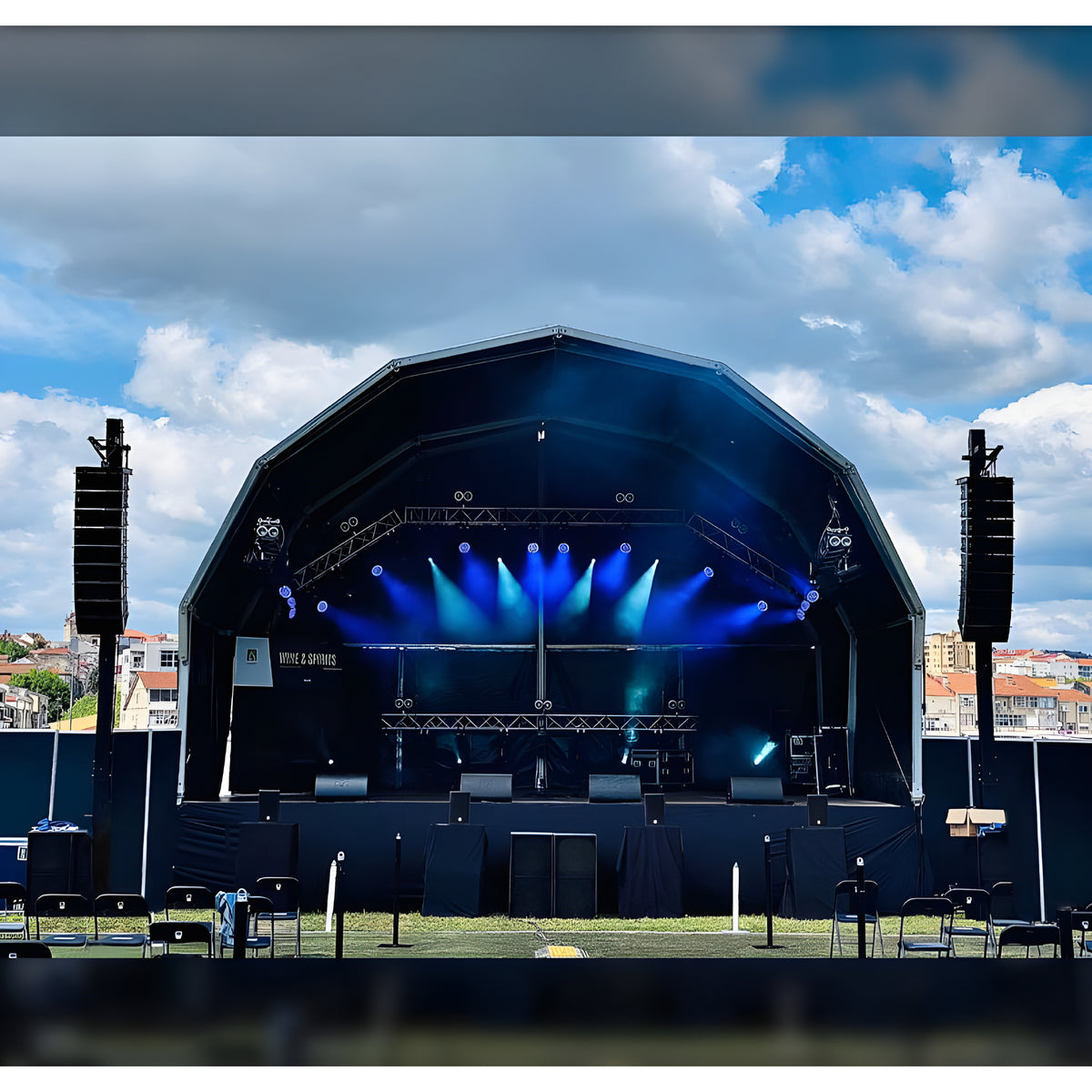
If you're planning an installation of this profile and want to validate your choice of tower, anchors, and load distribution on the platform, you can consult with the product team and review compatible configurations within the GUIL range in the ULK 650 , which represents a balanced starting point in terms of load-height and transport solutions. An early discussion with specialists prevents unnecessary oversizing and identifies essential accessories such as adapters or specific bases.
Top-loading for lighting and general support: telescopic towers with automatic locking
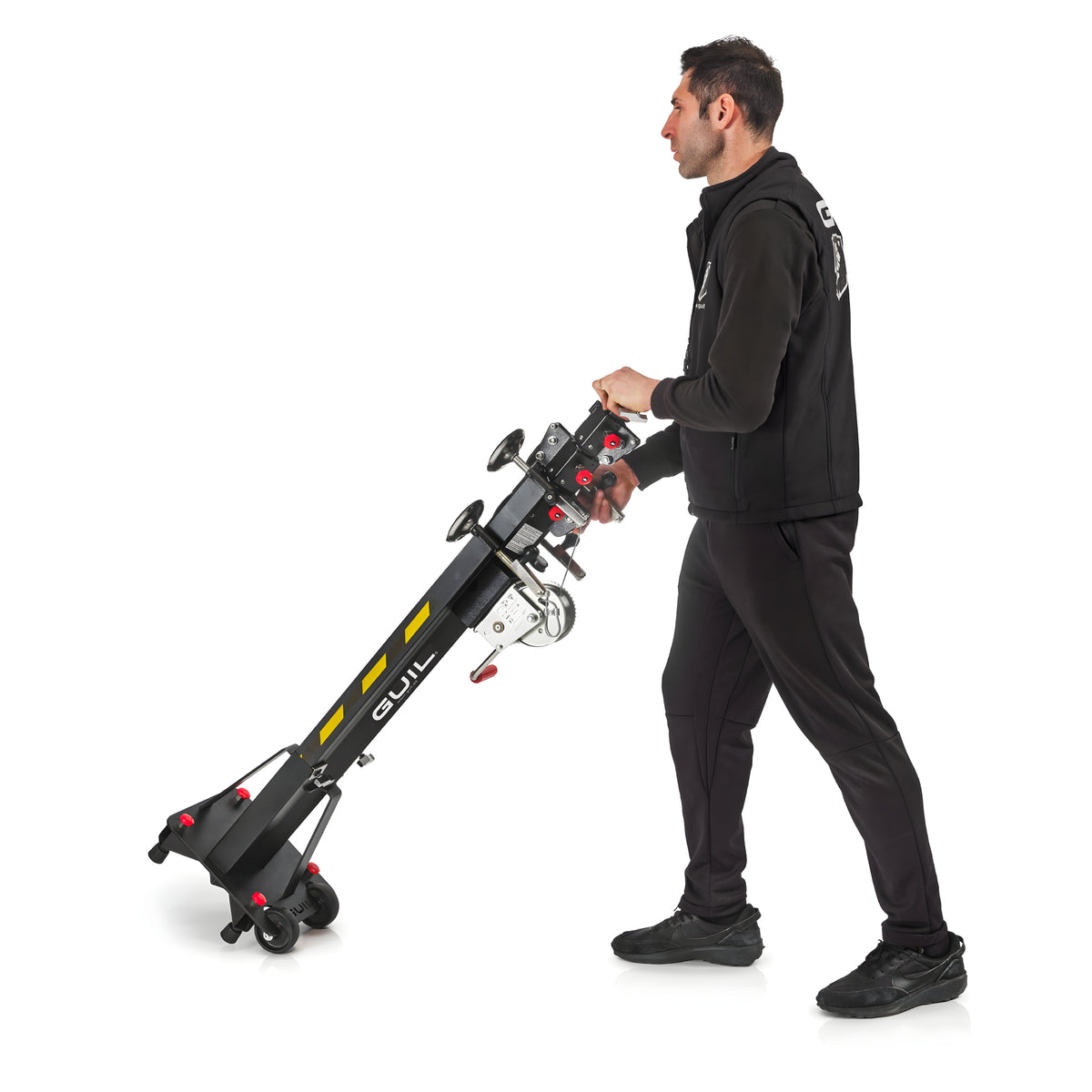
When the goal is to lift lighting bars, lightweight structures, or set pieces, a top-loading tower offers simplicity and speed. The presence of automatic locking systems reduces the risk of accidental descent due to improper handling and speeds up the operation by eliminating extra steps. In productions with rapid scene changes, minimizing critical points on the winch and retention system saves valuable minutes. A common option for jobs between 3.5 and 5 meters is to choose a lightweight and compact tower that is easily folded for transport and complies with current regulations for stage machinery.
To help you determine your capacity and height requirements, consider a top-loading telescopic tower with optimized geometry for transport. This model integrates an adapter head and a stable base for safe operation. At Tempo Shop, you'll find models with maximum heights ranging from 3.5 to 5.1 meters, typical rated loads between 125 and 150 kilograms, and compliance with applicable European standards. If you need a specific reference to estimate your needs, you can start with a lightweight, certified tower like the ELC 730 , which balances handling, capacity, and safety in professional lighting environments.
Integration with trusses and Ground Support structures: compatibilities that avoid surprises
The most evident strength of an ecosystem lies in the connection between towers and trusses. A square or parallel aluminum truss with a reliable connection system and appropriate accessories allows for the creation of gantries, side rails, and video supports with precise load control. The 290mm and 400mm truss families are common due to their stiffness-to-weight ratio, and when combined with lifting adapters and ground support towers, the result is a system that can safely expand in both footprint and height. Integrating electric motors with certified chains and limit switches within a modular solution enables rapid rig changes without compromising inspection requirements.
To plan these structures with a comprehensive overview, it's helpful to browse truss categories with filters for sections and accessories. At Tempo Shop, you can review geometries and joining accessories in the trusses section, which makes it easy to compare chords, diagonals, and fixing systems. If the project requires erecting a complete gantry using a hoist, it's advisable to consider ground support towers and their adapter kits from the outset, choosing heights compatible with the stage lighting and the venue's ceiling height.
Operational security plan: people, processes and documentation
Technology cannot compensate for a weak work chain. An operational safety plan defines roles, communications, and essential documentation from unloading to closure. The technical manager validates the suitability of the site, determines safety radii, and approves the work method. Pre- and post-use inspections are documented, the condition of critical components is recorded, and photographic evidence of anchors, leveling, and connections is maintained. Staff training reduces common accidents such as tripping in walkways, improper handling of winches, or unauthorized removal of pins. Coordination with production and site security prevents interference between assembly tasks and sound or lighting tests.
During the event, last-minute changes are the primary source of risk. A growing backline, a heavier video wall, or a PA adjustment that alters the geometry all require a complete reassessment. Documenting these variations and reconfirming the structure's stability prevents the accumulation of small decisions from leading to an out-of-specification state. At the end of the event, a post-use inspection allows for the detection of premature wear, deformations, or minor damage that, if corrected promptly, will not escalate costs or compromise the safety of the next setup.
Trends shaping 2025: integrated security and intelligent modularity
The sector has consolidated advances that are no longer up for debate. Automatic locking systems with positive detection, high-strength telescopic profiles with anti-corrosion treatments, and redundant internal brakes have raised the bar for lifting towers. At the same time, modularity is no longer limited to the platform: front-loading towers incorporate horizontal transport with integrated wheels, housings for compact storage, and geometries that optimize load distribution on increasingly smaller bases. The standardization of accessories, along with the publication of new, specific sections of European standards, is leading to clearer requirements in tenders and specifications, which benefits suppliers who opt for certified solutions from the source.
In modular stage design, innovation is progressing along two paths. On the one hand, platforms with improved weight-to-load ratios and durable finishes that withstand heavy use. On the other, integration solutions that facilitate organized cabling, stage edge management, and adaptation to special formats without sacrificing rigidity. In truss systems, the evolution focuses on improving connections, increasing compatibility between product families, and strengthening the documentation of each component's lifecycle. All of this results in faster operations, simpler audits, and a cleaner aesthetic.
How to choose wisely at Tempo Shop: compatibility, support and real stock
The first sensible step is to define the primary use and the target load and height range, and from there design a system with a realistic margin. If your focus is on general lighting and support, starting with a lightweight, top-loading telescopic tower compatible with 35mm adapters will give you a balanced starting point. For line arrays and cantilevered structures, a front-loading tower with ample capacity, reinforced forks, and horizontal transport will provide safety and agility in outdoor setups. In any case, the quality of the platform supporting the tower is crucial, as it's the physical base onto which the loads are transferred. If you need to explore options with birch plywood, aluminum profiles, and high load capacity, you can begin with the Stages and Platforms collection, where you'll find fixed and telescopic legs, skirt accessories, and connectors compatible with professional series.
To narrow it down to specific products and compare heights, weights, and regulatory compliance, it's helpful to create a shortlist with a certified top-loading tower, a front-loading PA tower, and a set of trusses and accessories compatible with your preferred dimensions. This way, you'll avoid overbuying and ensure that each piece fits the rest without needing makeshift adapters. If you prefer to start with a specific lightweight top-loading tower that meets the usual requirements for mobile lighting, the ELC 720 can serve as a reference for sizing needs and accessories. And if you plan to design gantries and side panels with future expansion in mind, it's advisable to validate the truss family and its connection system from the outset, as well as the ground support towers with hoists that allow for quick rig changes.
Mental checklist for a smooth editing process
Before loading the van, confirm that the rig plan and descriptive report accurately reflect the actual loads and accessories available. Upon arrival at the site, inspect the terrain, zone the work area, and place visible signage throughout the lifting process. Check for verticality and levelness before applying any load and verify that pins and locking systems are properly seated. Define clear wind thresholds and establish procedures if they are exceeded. Keep the potential fall area clear and don't let time pressure cause you to skip checks that take only seconds. At the end of the rig, document the condition of the equipment, clean and lubricate winches as needed, and record any issues for preventative maintenance. Repeating these practices is what separates a successful rig from one that relies on luck.
Next steps
Setting up a robust modular stage with efficient and safe lifting towers isn't about a single decision, but rather the sum of several small, well-chosen options. A comprehensive catalog with clear compatibility information, unambiguous regulations, and a technical team that adheres to established processes make all the difference between a smooth production and one that creates constant tension. If you're planning your next season, now is the perfect time to standardize your range of platforms, trusses, and towers, leverage economies of scale, and train your team on procedures that minimize errors. At Tempo Shop, we can help you compare real-world solutions, align expectations with your typical gig riders, and ensure your investment translates into less stress, greater safety, and a better experience for both your audience and your artists.
If you need immediate support to create your ideal setup with GUIL towers and compatible trusses, contact our specialists for a customized proposal. You can start by exploring the brand's full range and requesting advice on the GUIL page at Tempo Shop . If you already know you need to reinforce your rig system with portal frames and lifting accessories, get inspired by the options in the trusses section and compare them with the availability of platforms and legs in Stages and Platforms . And if you want to validate a specific tower for your next event, start with the ULK 650 for PA and the ELC 720 for lighting, and build your final accessory list from there.


